
Electropolishing
Material-flexible electropolishing for stent components and other precision parts, achieving surface finishes down to Ra 0.01 µm with reflectiveness exceeding 90 GU.
Ra 0.01 µm
Surface finish
> 90 GU
Reflectiveness, a mirror-like finish
Multi-material
Stainless steel, titanium, Nitinol and other alloys
Electropolishing at Brüsch
Material-flexible and contamination-free
Brüsch operates an electropolishing system, available for both stent components and other precision parts produced in-house. The process is material-flexible: stainless steel, titanium, Nitinol and other alloys can all be electropolished by selecting the appropriate electrolytic medium, with dedicated material-specific solution buckets used to ensure process integrity and avoid cross-contamination.
While electropolishing is currently applied to Brüsch's own produced components, external customer parts can be considered on a case-by-case basis.
The process removes a controlled micro-layer of material from the component surface, eliminating surface irregularities and achieving surface finishes down to Ra 0.01 µm with a reflectiveness exceeding 90 GU (gloss units), producing a mirror-like surface finish measurable by both Ra and gloss measurement.
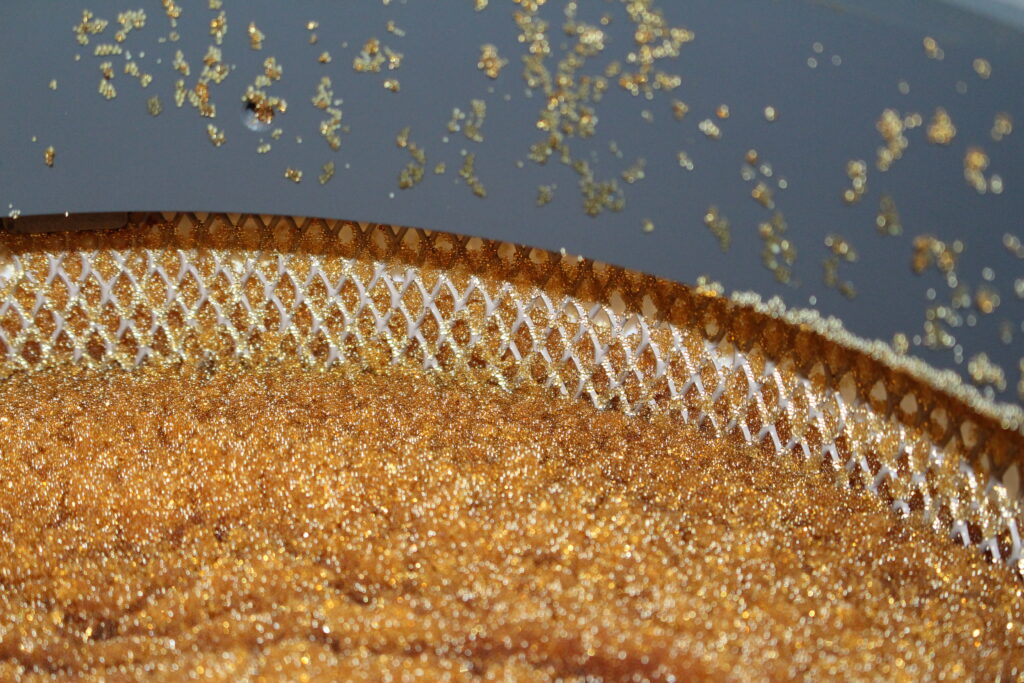
For MedTech and implants
Four critical functions
Passivation
Passivation of the metal surface to enhance corrosion resistance.
Biocompatibility
Improvement of biocompatibility by removing surface contaminants and free iron.
Cosmetic finish
Cosmetic finishing to the highest visual standard.
Reduced roughness
Reduction of surface roughness to minimise bacterial adhesion.
The process is applied as standard in the Nitinol wire stent production flow, following heat setting and preceding final ultrasonic cleaning, passivation and packaging.
Surface Finishing
More surface finishing
Grinding
STUDER S21 and S31 cylindrical grinding with surface finishes down to Ra 0.01 µm and tolerances of ±0.005 mm.
Read more →Honing
Precision honing for bore diameters from Ø30 to Ø50 mm and bore lengths up to 110 mm.
Read more →Glass Blasting
Fully automatic, custom-built glass bead blasting for controlled and repeatable surface treatment.
Read more →Ready to discuss your next component?
Send your drawing or RFQ to sales@brusch.dk, and we'll make sure it reaches the right specialist.